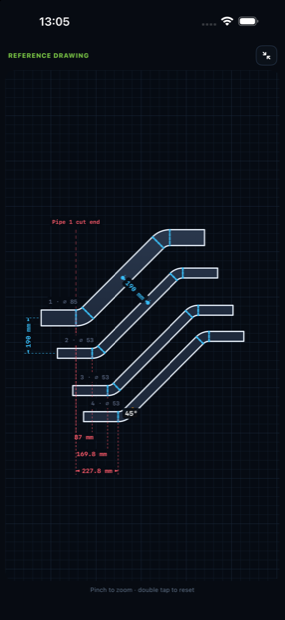
Two half elbows in one axis
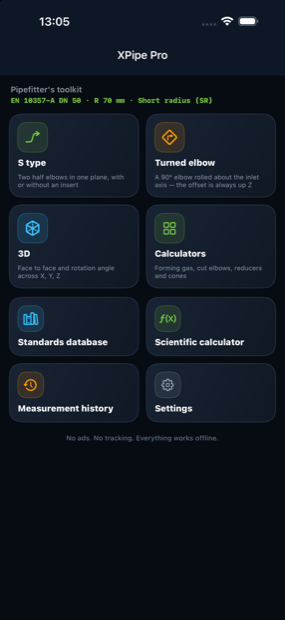
Two half elbows in one plane, with or without an insert. Tick what you know — angle, offset, length or insert — and the sketch shows live what will be worked out. Four new combinations, including the insert from the length and the angle from an insert already cut.
Change of axis direction
A 90° elbow rolled about the inlet axis — the offset is always up Z.
3D
A run across X, Y and Z. Both elbow angles are solved separately, because they differ — and the box you measure is drawn round the pipe, not round the theoretical corners. The headline figure is the insert between the two elbows — the pipe you actually cut.
Elbow cut
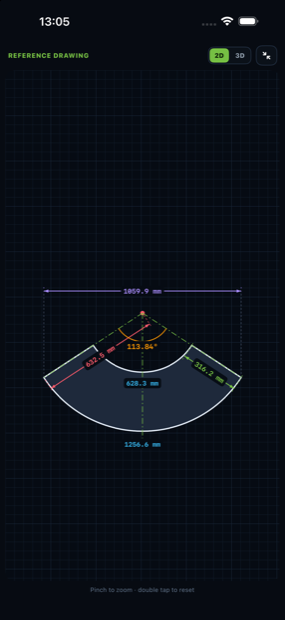
Cutting an elbow down to an odd angle: take-out, heel and throat arcs, chords, heights, and the arcs to mark back from the face you already have.
Forming gas
Purge time before the root pass, the gas it costs, and the inlet velocity that tells you the flow rate is wrong before the weld does.
Reducer cut
How far to cut a reducer back so its end comes out at the diameter you need — with the offcut and the cut plane drawn.
Cone layout
The sector to strike on flat sheet for a full or truncated cone, with the sheet it fits on, its area and what the finished part holds.
Square-to-round transitions
Twelve pieces off one construction: round over square or square over round, centred, offset on one axis or on both, with the square opening level or laid over — and a round pipe run down into a square or rectangular pyramid. Each returns the blank to cut, the true length from every corner out to its quarter of the circle, and the angle the sheet turns at each of those lines. The pyramid pair returns two patterns, because it is two jobs: the hole in the faces and the fishmouth on the pipe.
Pipe bank
Several lines making the same offset. Bend them all in one place and the spacing closes up on the slant; this says how far to hold each fitting back.
Segmented elbow
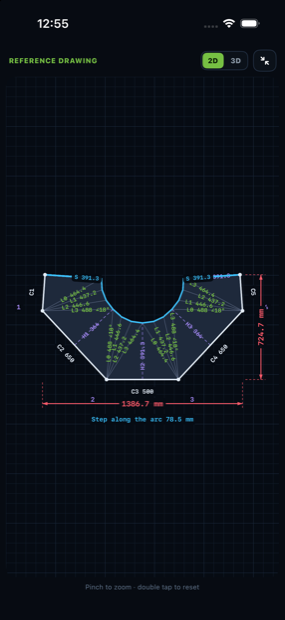
A bend built out of straight pipe. Every segment length, the angle to set the saw to, and the cosine wave to wrap round the tube to mark it out.
Branch / fishmouth
One pipe cut to sit on another, square or on the skew. The length to cut, the distance back from the face at 8, 16 or 24 stations round the girth, and the size, shape and position of the hole in the run. The deepest point of the cut changes formula as the branch lies down; the app knows where that happens.
Eccentric branch
The same joint with the two axes set apart, at any angle. Setting a branch across the run costs it its symmetry: the two horns stop matching, the deepest point of the cut wanders off the crotch, and the hole in the run needs both of its edges given at every station rather than one half-breadth. Each side is marked on its own, and an end view carries the centre distance — in elevation the offset lies along the line of sight and cannot be seen at all.
Elbow support
A tube cut to stand under a bend — the fishmouth again, with the run curved. The seat is a torus rather than a cylinder, so every figure comes off a different root: the length to cut, the ordinates round the girth, the height of the base plate, and the two angles at which the tube first touches the bend. Set it off to one side and the near and far horns stop matching, exactly as they do on an eccentric branch.
Falls
Per cent, mm per metre, one-in-something and degrees are four ways of writing one number. Type whichever the drawing used; the rest follow, with running levels down the line.
Volume and mass
The steel, what is in it, the lagging and the cladding — per metre for the hangers and in total for the crane. Plus the flooded weight, which is what a sling is really chosen against.
Pressure test
The gauge is down eight bar this morning: a leak, or a cold night? Water barely compresses, so a stiff system moves about 2.6 bar per degree. Whatever the cooling does not explain comes back in litres.
Thermal movement
ΔL for the actual grade, and the leg the movement needs. Held solid at both ends the stress is E·α·ΔT — over 400 N/mm² for stainless at 150 °C, and it does not depend on the length at all.
Cold spring
Cut the closing spool short, pull the ends together, weld. The run starts in tension and the nozzle sees half the reaction. The force it takes is worth reading first: thirty millimetres on a four-inch line is tonnes.
Dished heads
Klöpper, Korbbogen and ASME profiles — blank diameter, knuckle radius, straight flange and crown height, worked from the finished inside diameter. The three shapes hold different capacity off the same diameter, and the difference is in the numbers, not the eye.
Fillet weld
Converts a to z and back, filler metal per metre of leg, and an intermittent weld’s length and pitch — with the callout read back in words, so a6 and z6 are never taken for the same joint.
Weld preparation
V or J: the face width, the groove area and the filler a joint will take. On a heavy wall a J holds about half what a 60° V does, and the screen shows both so the saving is a number rather than a claim.
Weld shrinkage
One butt weld is a millimetre and nobody notices. Twenty on a rack run is two centimetres and the last spool does not reach. Work it out before cutting, and calibrate the figure on your own first spool.
Flange studs
Two flanges, a gasket, washers, nuts and the thread that has to show. ASME B16.5 gives the thickness without the raised face below Class 400 and with it above — read it the same way for both and every low-class stud is 3 mm short.
Support spacing
Three criteria at once: bending, sag, and — on a line that has to drain — whether the sag tilts the pipe back uphill faster than the gradient takes it down. The last one is not in the tables, and it is the one that catches hygienic work.
Pipe schedules
B36.10M and B36.19M wall thickness by schedule number, in inches and millimetres together, with the bore that thickness leaves — so a schedule number off a spec sheet becomes a wall you can actually measure for.
Pipe threads
ISO 7-1 / EN 10226 taper and parallel threads, R 1/16 to R 6: pitch, major and minor diameter, and the length of thread to cut — read off the size stamped on the fitting rather than guessed with a gauge.
Butt-weld fittings
EN 10253 / ISO 3419 dimensions for elbows, tees and reducers, DN 15 to DN 600 — centre-to-face and centre-to-end, the two figures a drawing gives and a spool sheet needs.
Flange tables
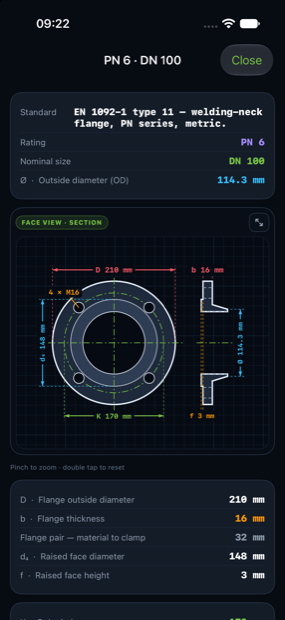
EN 1092-1, ASME B16.5 and the hygienic DIN 11853-2, drawn face-on beside the section — because the section gives you the thickness and the section alone never tells you where the holes go. Bolt circle, hole size, count and the chord between two neighbouring holes, which is how a pattern is checked with a calliper rather than a protractor.
Standards database
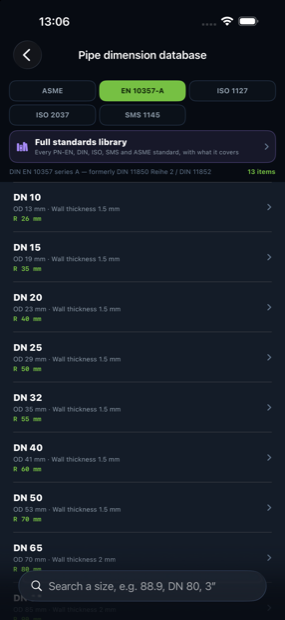
Searchable pipe tables with short, long and orbital elbow data, plus every standard the trade quotes and the fittings each one defines.
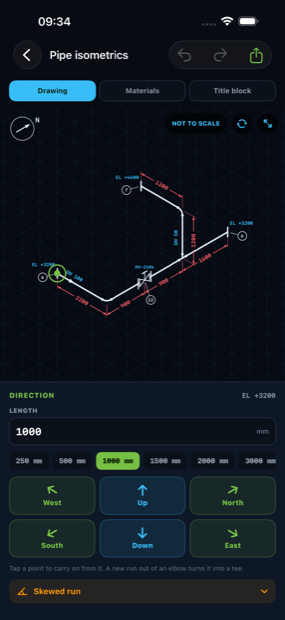
Isometric drawing
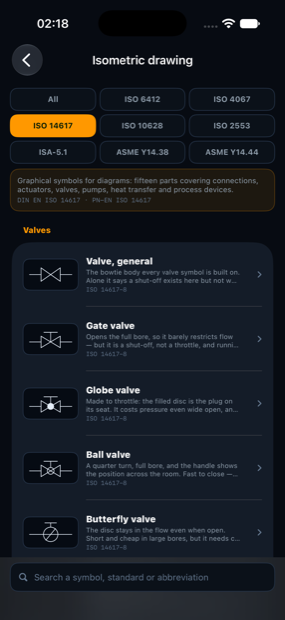
The symbol sheet: 239 marks from ISO 6412, ISO 4067, ISO 14617, ISO 10628, ISO 2553, ISA-5.1, ASME Y14.38 and ASME Y14.44 — every one drawn, named and explained in a line. Search matches the lettering inside a symbol too, so BW, PIC or =G1 finds itself. One button drops the partition between standards, which is what an unknown mark actually needs.
Bolt torque
Torque at the wrench, computed rather than copied off a table: stress area from the thread form, load from the grade and the share of yield you are pulling to, torque from the nut factor. The nut factor sits among the results with its own figure showing, because published values scatter by a third and everything downstream moves with it.
Wall thickness
The wall a pressure needs under ASME B31.3 or EN 13480, the schedule it comes to, and a check of the pipe on the bench.
Heat input and preheat
Arc energy from voltage, current and a timed run, and the preheat EN 1011-2 calls for.
Pressure drop
Losses along the pipe and through its fittings by Darcy–Weisbach, and the size a velocity calls for.
Tube bending
Bend marks, gain, cut length and springback for a tube bender.
Breeches piece
One pipe into two of the same size: the cut on all three pipes, as DXF or printed 1:1.
Postweld heat treatment
Whether a weld needs PWHT under ASME B31.3, at what temperature and for how long.
Welder qualifications
What an ISO 9606-1 or ASME IX certificate covers, and reminders before it lapses.
Level
The only screen that measures instead of calculating. Lay the phone along a pipe and read the fall that is already there, in degrees, per cent, millimetres per metre or one in something. Zero it on a surface you trust and the reading cancels both the phone's own case and the crown of the pipe.